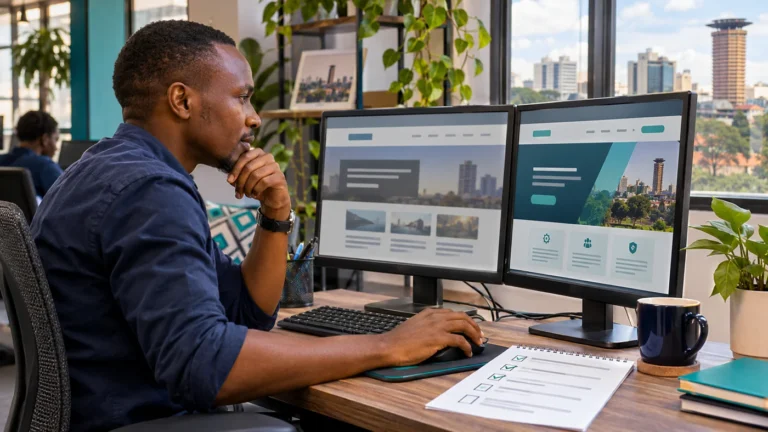
Someone receives your website link on WhatsApp. Another person finds your name through Google. A customer opens your product page from a social media post.
Their next step may happen entirely on a smartphone.
For businesses, organisations and political candidates in Kenya, a professional website needs to work comfortably on that screen. Visitors should be able to read, explore and contact you without struggling with tiny text, slow images or complicated navigation.
Kenya’s smartphone figures reinforce the importance of designing for mobile access.
What Do Kenya’s Smartphone Statistics Show?
The Communications Authority of Kenya’s report for April–June 2026 recorded approximately 52.3 million smartphones connected to mobile networks, compared with 50.2 million in the previous quarter.
The report also recorded approximately 64.3 million mobile data subscriptions and 54.9 million mobile broadband subscriptions at the end of June 2026.
These figures describe devices and subscriptions. They should not be presented as the number of individual Kenyans who own smartphones or use mobile internet.
One person can use several devices or subscriptions. That distinction matters when interpreting smartphone penetration.
Smartphone Penetration Is Different From Individual Ownership
A smartphone penetration figure generally relates the number of connected smartphone devices to a population estimate. It does not automatically tell us what percentage of individuals personally own a smartphone.
Device penetration, smartphone ownership and internet usage answer different questions:
- Device penetration: How many connected devices are recorded relative to the population?
- Individual ownership: How many people own a device?
- Internet usage: How many people report using the internet?
The practical implication for website owners is straightforward: mobile access deserves serious attention, while other ways of contacting your business or organisation remain useful.
Your Website Should Make the Next Step Easy
A website can look impressive on a large computer screen and still be frustrating on a phone.
Visitors may struggle if the menu is difficult to open, important text appears inside an image, or a contact button sits underneath another element.
A useful mobile website should help someone complete a clear task, such as:
- Finding your services.
- Reading a biography.
- Reviewing products and prices.
- Downloading a document.
- Submitting an enquiry.
- Calling your team.
- Completing an order.
Design starts with those tasks.
What This Means for Candidate Websites
A candidate website gives the public a structured place to find approved information.
On a phone, visitors should be able to identify the candidate, read their background, explore published priorities and locate official contacts.
A manifesto page can provide a readable summary alongside a download. News should have clear dates, and event listings should show confirmed details.
The aim is accessible public information that remains easy to navigate across different screen sizes.
What This Means for Business Websites
A prospective customer should quickly understand what your business offers and how to make an enquiry.
For a consultancy, that might mean clear service descriptions and a working contact form. For a college, it could mean course information, application requirements and intake enquiries.
For a supplier, it may mean a product catalogue with a quotation button.
The website should reflect the process your team can actually support.
Online Stores Need a Complete Mobile Journey
An online shop needs more than product pages that fit on a phone.
Customers should be able to select an item, understand variations, check delivery charges and complete the available payment process.
Before launch, test the entire journey:
- Open a product from a shared link.
- Choose the required options.
- Add it to the cart.
- Review delivery or collection details.
- Complete a test transaction.
- Confirm that the order reaches the business.
This helps identify problems that a homepage review would miss.
Keep Pages Comfortable to Use
Readable text, appropriately sized images and straightforward navigation support a better mobile experience.
Avoid automatically playing large videos or placing essential information only inside downloadable files. Keep forms focused on the details needed to handle the request.
Test the website on an ordinary phone connection as well as office Wi-Fi. Check different screen sizes and confirm that important controls remain visible.
Build a Website Around Your Visitors
Kenya’s smartphone growth gives businesses and public-facing organisations a strong reason to prioritise mobile usability.
The objective is a website that helps visitors find information and take the next step with confidence.
Top Web Design Kenya builds business websites, online stores and candidate websites with mobile-friendly layouts, clear content and practical enquiry options.
Explore our website services or request a website quote.
Call or WhatsApp: 0721 985 722
Email: mail@topwebdesign.co.ke